
Skip to content
  • About Us
  • Write for Us
  • Contact
  • Donate
  • People
  • Newsletter
  • Sciworthy’s Professor Partnership Program
    • About the Program
    • All PPP Articles
    • Emmanuel College
    • New Mexico Tech
    • Raritan Valley CC Biology
    • RWU and Tufts Cancer Biology
    • St. Lawrence Neuroscience
    • Trinity Geology
    • University of Delaware
Skip to content

Sciworthy

  • Home
  • Read by Big Question
    • How do computers learn?
    • How do scientists study drugs and vaccines?
    • How do we treat infectious diseases?
    • What is the status of cancer research?
    • What new treatments are there for neurodegenerative diseases?
    • What do we know about mental health?
    • What is the biological basis of aging?
    • How do we educate our kids?
    • How do we feed people now and in the future?
    • What effects do different foods have on our bodies and health?
    • What new technology is coming around the corner?
    • How does technology impact our daily lives?
    • What might life look like elsewhere in the Universe?
    • How could humans travel in space?
    • What is out in space?
    • What happened in Earth’s past?
    • What is going on with the Earth’s climate?
    • How do microbes respond to changes in their surroundings?
    • How can microbes clean up the environment?
  • Read by Topic
    • Agriculture
    • Archaeology
    • Astrobiology & Space Science
    • Astronomy
    • Biology
    • Chemistry
    • Computer Science
    • Earth Systems
    • Ecology
    • Education
    • Engineering
    • Environment
    • Food Science
    • Geography
    • Machine learning and AI
    • Medicine
    • Microbiology
    • Neuroscience
    • Oceanography
    • Paleobiology
    • Physics
    • Psychology
    • Space
    • Sustainability
    • Technology
    • The Force
  • Take Our Courses

Sciworthy

The Encyclopedia of Science's Frontier

Home » JWST

Tag: JWST

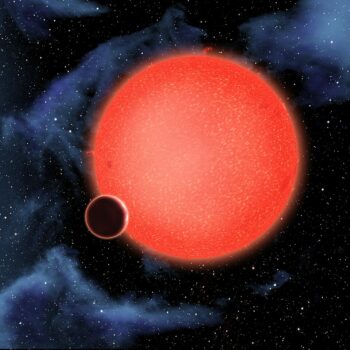
Exoplanet GJ 1214b
shadow

The lifecycle of a steam world

Posted on October 6, 2025October 6, 2025 by Ben Pauley

Scientists studied exoplanets with high water contents and found that they initially have outer vapor layers, which then cool and shrink…
    Read More
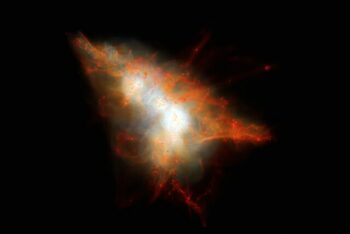
    This rendering shows a snapshot from a cosmological simulation of a Lyman-alpha Blob similar to LAB-1. This simulation tracks the evolution of gas and dark matter using one of the latest models for galaxy formation running on the NASA Pleiades supercomputer. This view shows the distribution of gas within the dark matter halo, colour coded so that cold gas (mainly neutral hydrogen) appears red and hot gas appears white. Embedded at the centre of this system are two strongly star-forming galaxies, but these are surrounded by hot gas and many smaller satellite galaxies that appear as small red clumps of gas here. Lyman-alpha photons escape from the central galaxies and scatter off the cold gas associated with these satellites to give rise to an extended Lyman-alpha Blob.
    shadow

    Astronomers find distant galaxies with neural networks

    Posted on April 7, 2025June 25, 2025 by Ben Pauley

    Researchers developed a computer algorithm that correctly predicted the light emission characteristics of ancient faraway galaxies based on…
      Read More
      shadow

      Searching for the first supernovae in the universe

      Posted on November 4, 2024June 25, 2025 by Ben Pauley

      Astronomers developed new theoretical models for how stars evolve that suggest the JWST could glimpse the oldest stars in the universe…
        Read More
        shadow

        Astronomers discover new rare hot Neptunes

        Posted on August 26, 2024June 25, 2025 by Ben Pauley

        Scientists discovered 2 new examples of medium-sized, closely-orbiting exoplanets whose characteristics shed light on how planetary systems…

          Read More
          Youtube Bluesky Facebook Instagram Twitter TikTok

          Video – Aerogels for Oil Spills

          https://www.sciworthy.com/wp-content/uploads/2025/08/Sciworthy-Aerogel-for-Oil-Spills.mp4

          What’s New in Space Science?

          Artist's impression of the planetary system around the red dwarf Gliese 581. Credit: ESO

          Unlock Your Potential!

          Unlock Your Potential!
          shadow
          shadow
          shadow

          Help us help you!

          We want to know how Sciworthy can better serve our readers. Take our 5-minute survey and tell us your thoughts!

          Take the Survey

          Sciworthy’s content is Creative Commons, No Derivatives, With Attribution. Read more about the license here.