

A special group of soil bacteria, called Plant Growth Promoting Bacteria (PGPBs), helps plants grow and remain healthy. PGPBs typically live in the narrow zone of soil immediately around plant roots, called the rhizosphere, or within plant roots, called the endosphere. They stabilize nutrients and fight off plant diseases, improving plant health.
PGPBs are the main component in mixtures of living microorganisms that farmers apply to crop fields, called biofertilizers. Biofertilizers are considered a “greener” alternative to common chemical fertilizers, so developing mixtures of PGPBs is a primary goal for sustainable crop management.
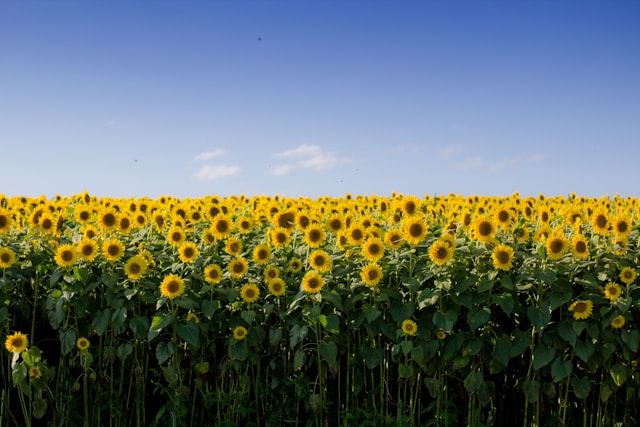
A team of researchers in Italy studied how 3 mixtures of PGPBs affected the natural microbial populations in the rhizosphere and endosphere of 2 sunflower varieties. Their goal was to assess whether PGPB inoculants had lasting effects on sunflower microbial communities. They also tested whether there was a noticeable difference in the microbial communities of naturally-produced versus genetically-modified sunflower varieties.
The researchers first identified bacterial strains that promoted plant growth by producing acids, like indolelactic acid, that enhance heavy metal and drought resistance or dissolve minerals to release nutrients. They grew 40 strains of bacteria from honeybee guts, pollen, wheat rhizospheres, and fruit plants, and tested whether they could produce acids. From these tests, they created 3 mixtures of PGPBs, including one with 6 Bacillus strains, one with 3 Lactobacillaceae strains, and one with 2 Paenibacillus strains.
To test the PGPB mixtures on real crops, the team conducted 2 years of field experiments in northern Italy, in 2023 and 2024. The experiments consisted of 24 field plots, including 12 plots with a genetically-modified hybrid variety of sunflowers, and 12 plots with a naturally-produced open-pollinated variety of sunflowers. The researchers applied the 3 PGPB mixtures to 3 plots each, so that there were 9 plots with microbes and 3 control plots without microbes for each sunflower variety. They applied the PGPB mixtures to the plots at 4 different times during the growing season by adding them to the irrigation water. The irrigation water for the control plots contained no microbes.
Once the sunflowers bloomed, the researchers harvested the plants and washed the roots with a sterile saline solution to separate the rhizosphere soil microbes from the endosphere root microbes. They extracted the microbial DNA from the samples and analyzed a specific gene region to identify the microbes, a process called 16S rRNA gene sequencing.
When the researchers first reviewed their data, they found that the microbial communities were very different between the 2023 and 2024 field experiments, likely due to temperature and rainfall changes. So to better assess how effective the PGPB treatments were, they analysed the data for each growing season separately. They found that the microbial communities in the inoculated sunflowers were different from those in the controls. They observed that the hybrid sunflowers had more pronounced changes in both their rhizosphere and endosphere microbial communities than the open-pollinated variety, indicating that the hybrid plants responded more strongly to inoculation.
The team also classified several microbial taxa as “treatment indicators,” meaning their abundance differed in a statistically significant way between the treated hybrid sunflowers and the controls. The endospheres of treated hybrids had fewer Pseudonocardiaceae and Nocardioidaceae phyla, and more Blastocatellaceae and Flavobacteriaceae phyla than the controls, while their rhizospheres had fewer Pseudomonadaceae and Bacillaceae phyla, and more Gemmataceae and Vicinamibacteraceae phyla. They explained that these microbes were already present in the soil and a part of the sunflowers’ natural microbiome before the PGPB mixtures were applied.
The researchers also compared the control plots to see if the 2 sunflower varieties had naturally different microbes. They found no obvious differences in the abundance of microbial phyla between the varieties. In fact, the microbial communities in the rhizosphere of both varieties were similar. Namely, Bacillota, Pseudomonadata, and Actinomycetota phyla made up about 31%, 23%, and 16% of the hybrid sunflowers’ rhizosphere microbial communities, and 29%, 25%, and 16% of the open-pollinated sunflowers’ rhizosphere microbial communities.
Finally, they assessed whether the rhizosphere and endosphere microbes were similar to each other in both varieties of sunflowers. They found that the populations of certain microbial families in the endosphere, like Streptomycetaceae and Burkholderiaceae, increased and decreased at the same rate as microbial families in the rhizosphere. This suggested to the researchers that microbes could be directly transferred between the rhizosphere and the endosphere, or that the sunflowers could be actively selecting for different microbes.
The team concluded that their PGPB mixtures changed the sunflower rhizospheres and endospheres by enriching certain key microbes. They suggested that scientists could someday design custom microbial biofertilizers to help specific crops withstand drought and disease or increase produce yields. They proposed that future researchers continue to study biofertilizers and microbes as active players in the soil ecosystem.
