

Climate models predict that temperatures will rise by 2 to 4°C (about 4 to 7°F) by the end of this century. Cold-blooded animals, or ectotherms, rely on ambient temperatures to regulate their body heat, making them sensitive to environmental changes. Tropical environments have relatively stable temperatures year-round, so tropical ectotherms rarely experience large fluctuations in heat. As a result, they are less tolerant of temperature changes and may be vulnerable to heat stress.
Social insects, such as ants and bees, are ectotherms that adjust their behavior to temperature changes at the individual and colony levels, making their responses to warming difficult to predict. Tree-dwelling ants often exchange services with their host plants in a relationship called mutualism. These ant-plant interactions can also affect other species. For example, some birds prefer to nest in acacia trees defended by ants. Disruptions to this mutualism due to ongoing warming could therefore have rippling effects throughout the ecosystem.
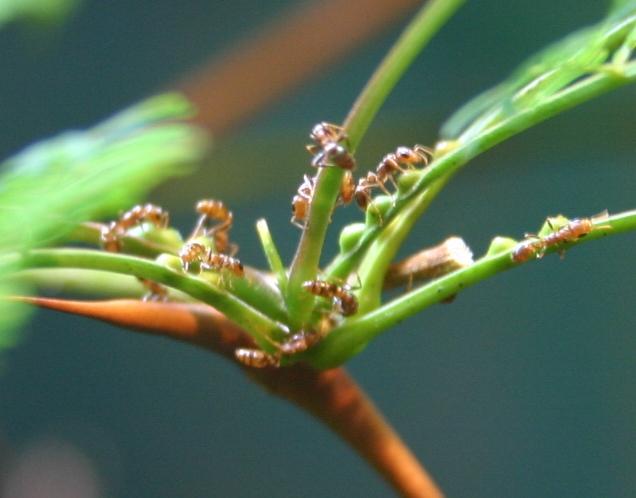
To understand how rising temperatures may alter mutualism, researchers examined how exposure to direct sunlight and experimentally increased temperatures affect the behavior of tree-dwelling tropical ants. They conducted the study in Parque Natural Metropolitano in Panamá from February to April 2024, and focused on an ant species that forms an interdependent relationship with the bullhorn acacia plant. In exchange for food and shelter, these ants protect the plant from herbivores and clear away competing vegetation.
The researchers built open-top plastic enclosures around 33 acacia trees, each with established ant colonies, evenly distributed between sun and shade. Sixteen control enclosures allowed ventilation through holes in the plastic, while 17 heated enclosures were sealed at the bottom and contained black paper to absorb and radiate heat. The temperature in the heated enclosures was about 1.3°C (2.3°F) higher than in the control enclosures.
After 1 week, the researchers measured ant activity on branches twice in the morning, between 7:00 and 9:30 am, and twice in the afternoon, between 12:00 and 3:30 pm. They marked a point on each branch, counted how many ants crossed it in 3 minutes, and recorded branch and thorn temperatures and whether the branch was in sun or shade. They observed that colonies in heated enclosures were less active than controls, especially on leaves exposed to direct sunlight and during the afternoon. Ants avoided exposed surfaces and moved inside the thorns. Although the thorns were about 2°C (3.6°F) warmer than the branches, the team said thorns protected the ants from direct sunlight, concluding that ants adjust their behavior to cope with heat.
To test whether higher temperatures affected ant defense, the researchers pinned a leaflet of an ear tree at the base of the acacia trunk and counted how often ants interacted with it. They found that ant colonies in the heated enclosures defended against the foreign leaf less than those in the controls.
Next, the researchers measured the maximum temperature at which the ants could no longer function, which they referred to as their Tmax. They collected 3 worker ants from each colony both before setting up the enclosures and 3 weeks after. They placed each ant in a tube at 36°C (97°F), and increased the temperature by 2°C (3.6°F) every 10 minutes. They gently tapped the tubes to see if the ants could stand, and recorded the temperature at which they could no longer recover as their Tmax.
Across 33 ant colonies, the team observed an average Tmax of 46.5°C (115.7°F), with no difference between the control group and the heated groups. They also measured Tmax in the same ant species from a hotter, drier forest and found similar values (about 48°C or 118°F), indicating that these ants naturally have a limited ability to withstand higher temperatures. They noted that the branch temperatures from their experiment reached 48°C (118°F), meaning the ants are already living near the highest temperature they can tolerate.
The researchers concluded that the ants became less active in response to heat, which weakened their defense of acacia plants. They speculated that this behavioral change could make the plants more vulnerable to herbivores and disrupt their interactions with other species, including pathogens and birds. They noted that future warming could have cascading effects throughout the ecosystem, so they recommended that future researchers examine how climate stress impacts these interdependent relationships and their broader ecological consequences.

