

The Star Wars series depicted alien heroes fighting against evildoers and their planet-destroying superweapons “a long time ago in a galaxy far, far away.” But what do scientists really know about alien planets in distant galaxies beyond our own? These worlds, known as extragalactic exoplanets, are expected to exist, assuming the Milky Way is no different from other galaxies. However, we have yet to find them since other galaxies are still too far, far away for modern exoplanet-observing techniques.
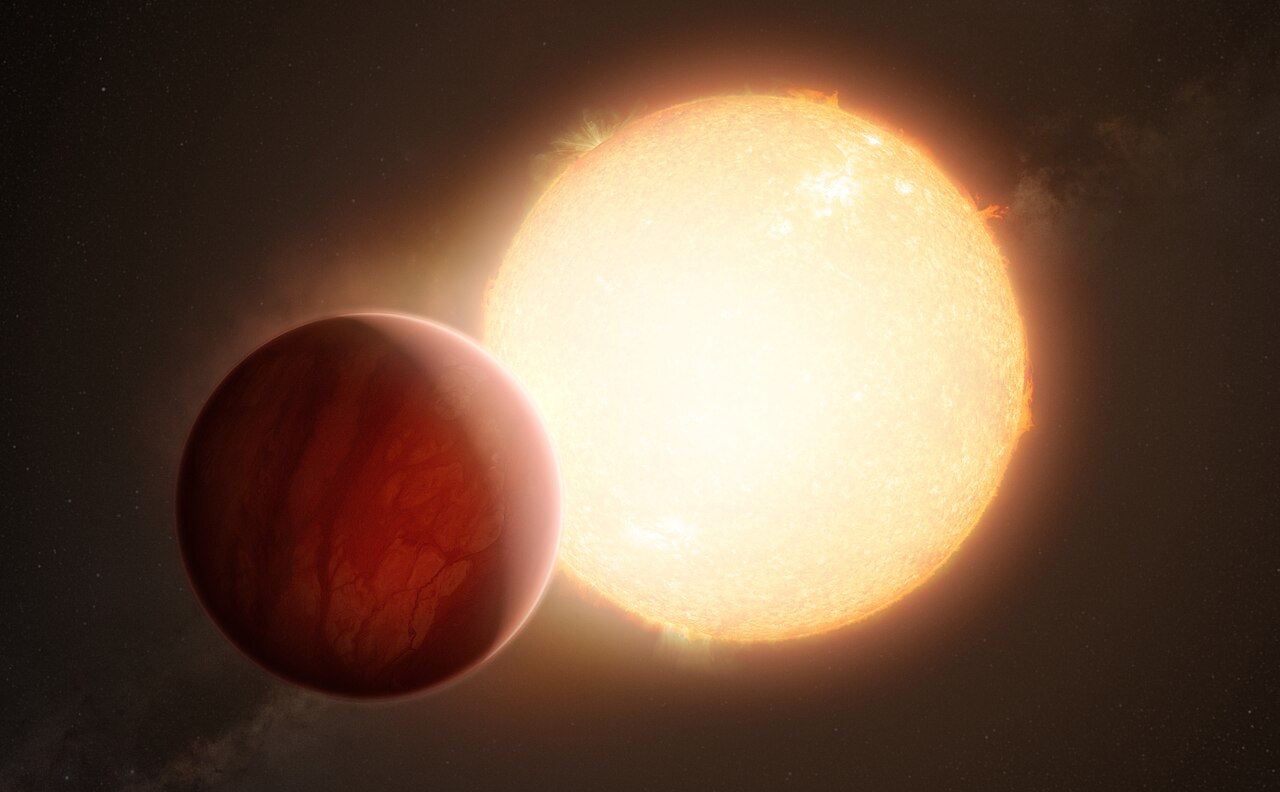
Recently, a team of astronomers analyzed a stream of over 700,000 stars that the Milky Way likely absorbed from the dissolving Sagittarius dwarf galaxy. These stars are very distant, so the team investigated whether any of them host large, close-orbiting exoplanets called hot Jupiters, which are relatively easy to find.
They established a set of 3 criteria to narrow down their list of stars. First, each star should appear bright enough when observed by the Transiting Exoplanet Survey Satellite, or TESS, to ensure high-precision results from the team’s data processing software. Second, each star must have more than a 50% likelihood that it originated from the Sagittarius dwarf galaxy, based on motion and position measurements from the Gaia mission. Finally, each star should have a radius of less than twice the Sun’s, as it’s easier to find planets around smaller stars. They used these criteria to limit their candidate list to around 20,000 stars.
After selecting their candidate stars, the team analyzed publicly available TESS catalog data using the software packages eleanor and TESS-Gaia Light Curve, or TGLC. These tools allowed them to plot each star’s brightness over time, in graphs called light curves. Then, the astronomers looked for periodic brightness dips in these light curves as evidence that an exoplanet passed in front of the star. From this, they excluded several thousand additional stars with too much light interference from their surroundings, reducing their final sample size to just over 15,000 stars.
To find hot Jupiters, the team looked for brightness dips at intervals of 14 hours to 10 days, which is the typical orbital period range for hot Jupiters. Then, they used geometry to derive each exoplanet’s radius from the fraction of the starlight it blocked. They excluded candidates with dips corresponding to objects with radii at least twice that of Jupiter’s, as these are likely caused by orbiting companion stars rather than exoplanets.
Among all the stars they surveyed, the team’s strongest candidate to host a hot Jupiter was a star labeled TIC 92223525. They calculated that this star could host an exoplanet with a radius 1.76 times the size of Jupiter’s and an orbital period of 7.2 days. However, when they reviewed this star’s light curve, they found that it was likely contaminated by its neighbor, TIC 92223526. The regular brightness dips from this system of orbiting stars mimicked that of an exoplanet, creating a false positive for TIC 92223525 that was difficult to detect during initial screening. As a result, the team ultimately excluded this candidate, leaving them with no confirmed exoplanets.
The researchers drew several conclusions from their inability to find hot Jupiters in their sample of stars from the Sagittarius dwarf stream. They estimated that if more than 1% of these stars hosted hot Jupiters, it would have been highly unlikely not to detect one in a sample of over 15,000 stars. This places an upper limit of about 1% on the occurrence rate of hot Jupiters. If this estimate is accurate, then even an ideal exoplanet search team would need to examine over 11,000 stars to find an extragalactic hot Jupiter. Accounting for more realistic levels of scientific uncertainty, a future team would likely need to study at least 80,000 stars to find one.
Although this survey of the Sagittarius dwarf stream yielded null results, the team suggested that future researchers continue searching it and other star streams from different galaxies. Scientists have identified over 20 such streams in the Milky Way. Researchers studying these streams could find the first extragalactic exoplanet or provide evidence that other galaxies produce fewer hot Jupiters than our own. But let’s hope none of them find the first extragalactic Death Star!

