


In the 1970s, astronomer Vera Rubin analyzed a series of observations of how quickly different galaxies rotated around their centers. She found that these galaxies rotated much faster than they should have, given the amount of material visible through starlight. She concluded that a large fraction of these galaxies’ masses must therefore consist of some kind of unseen material.
Scientists have since observed galaxies to more precisely measure this unseen material, which they now call dark matter. They’ve shown that dark matter moves much more slowly than the speed of light. Unlike most celestial objects, it can’t emit or block any light, meaning it doesn’t interact with the electromagnetic force. Even though it doesn’t interact with a fundamental force in the universe, dark matter constitutes over 80% of the mass of an average galaxy.
In the prevailing model of cosmology, known as ΛCDM (pronounced “Lambda-CDM”), dark matter determined where galaxies formed. The theory is that gravity pulled dark matter together more quickly than regular matter in the primordial universe. This redistribution led to regions of space with greater mass density, which collected chaotic, regular matter into pools that eventually formed galaxies, stars, and planets.
In the present universe, dark matter and regular matter coexist in galaxies, though generally separated. Regular matter pools in the very center of galaxies, forming the more familiar galactic disks. Dark matter stays towards the edges of galaxies, enveloping the regular matter disks in what are known as dark matter halos. Because these halos make up so much of the mass of the average galaxy, researchers Guangze Sun, Fangzhou Jiang, and Jing Wang conducted a series of simulations to test how dark matter halos affect regular matter in galaxies. Specifically, they examined what characteristics of dark matter halos determine galaxy sizes.
The force of gravity works such that more massive dark matter halos draw in more regular matter and produce larger galaxies. So these researchers fixed the total mass of the galaxies they simulated at 100 billion times that of the Sun to determine which properties of the dark matter halos would produce the widest galaxies. They selected 4 variables to test: the total density of dark matter in the galactic halo, the density of dark matter in the innermost 1% of the halo, how fast the halo spun, and the ratio of regular matter to dark matter in the entire galaxy. For each variable, they tested 3 to 4 inputs representing low, moderate, and high values against a standard reference value and ran 132 total simulations to generate enough data for statistical analyses.
To simulate the complex physics of dark matter halos, the team used the modeling software GIZMO to model gravity, magnetism, and fluid dynamics. They combined this with a second model, called FIRE-3, which modeled how stars explode at the end of their lives, how much metal these explosions produce, and how gases heat up and cool down over time. The researchers ran the dynamic simulations for 3 billion model years, then used a program they developed based on the existing Pynbody to measure the radii of the simulated galaxies.
The team found that the faster a dark matter halo spun around a simulated galaxy, the larger the galaxy became, as shown in scenario 1 in the figure below. By contrast, in scenario 2, increasing the halo’s total dark matter concentration caused the central galaxy to shrink. Increasing only the innermost dark matter density in the halo had a smaller effect but generally reduced the galaxy’s size, as shown in scenario 3. And lastly, increasing the ratio of regular matter to dark matter in galaxies resulted in smaller galaxies that formed stars closer to their centers, as shown by a greater concentration of stars in scenario 4.
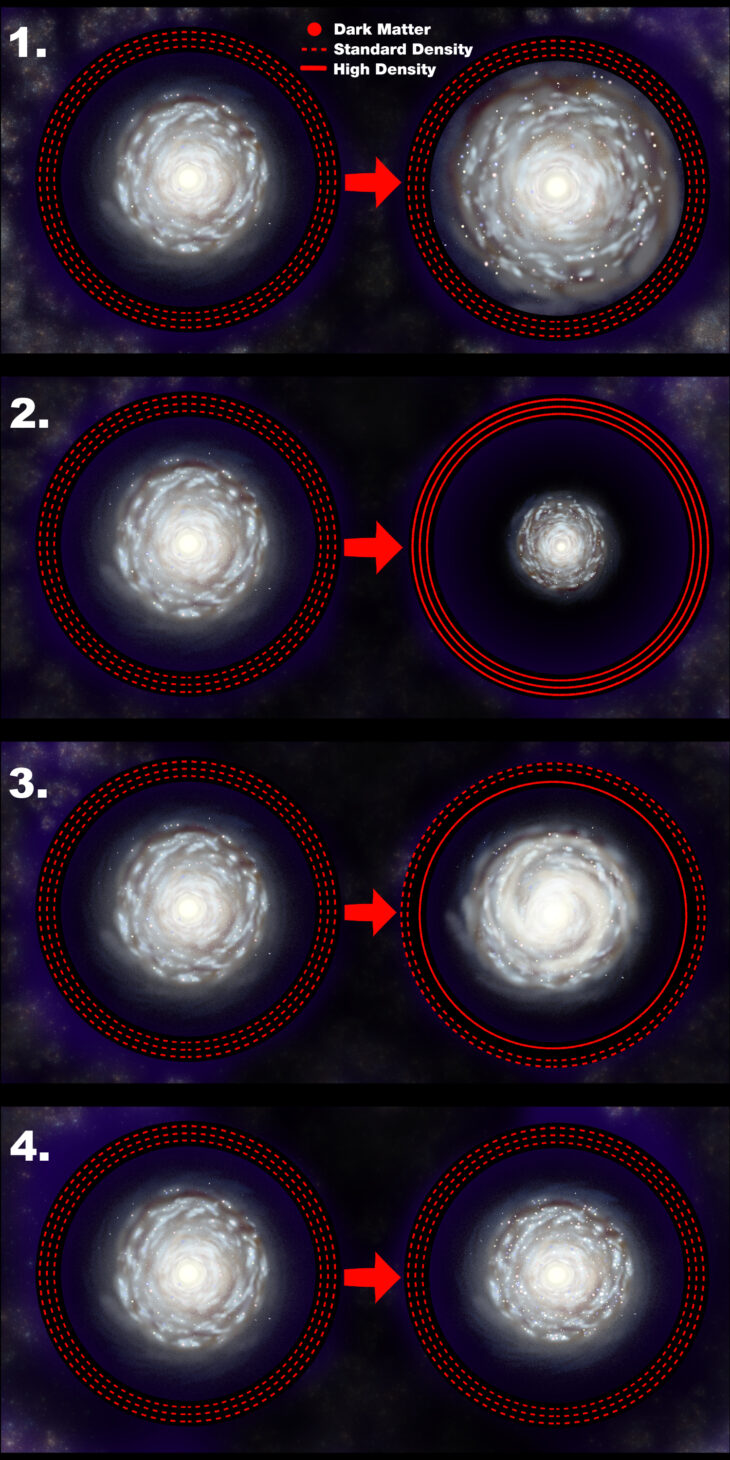
This diagram showcases the team’s results across 4 broad scenarios. The left column depicts a default galaxy under the baseline parameters. The right column depicts how the galaxies changed when the team varied a single experimental factor, including 1) increasing how fast the dark matter halo spun, 2) increasing the total density of the dark matter halo, 3) increasing the density of dark matter in the innermost halo, and 4) increasing the ratio of regular matter to dark matter in the entire galaxy. The dark matter haloes are represented as red rings surrounding the galaxies, not to scale. Illustration by Andrew Bizal.
The team’s results suggest a previously unknown connection between the properties of dark matter halos and galactic disks. However, they cautioned that their simulations were all run on galaxies in isolation, unlike in the actual ΛCDM universe, where their interactions are complicated by galaxies tugging on one another or by material moving from one to another. To further test their results for single galaxies, the researchers plan to run follow-up experiments with halos of different sizes, as well as with galaxies with different shapes and features, such as clumps, gaps, and lopsidedness.

