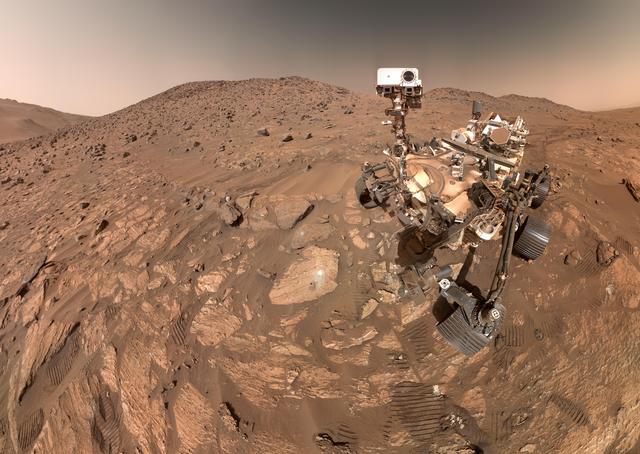

Since the 1976 Viking missions, when NASA first successfully placed uncrewed landers on Mars, scientists who study life in the universe, known as astrobiologists, have been gathering evidence to determine whether microorganisms ever lived on the red planet. It has been a challenging determination to make. Until a Mars sample return mission occurs, all necessary analyses must take place on Mars, using instruments designed as much to withstand the stresses of space travel as to collect data, which limits how thoroughly scientists can study Martian rocks. As a result, the search for evidence of microbial life on Mars is inherently incremental.
Recently, scientists added another piece of exciting, yet inconclusive, evidence to their search. In the summer of 2024, the Mars 2020 Perseverance Rover science team was searching for signs of ancient microbial life in a 3,700-million-year-old lake bed on Mars, known as Jezero Crater. In the process, they detected complex, carbon-containing organic molecules in mudstones within a river channel that once brought water to the now-dry lake bed.
This is not the first time complex organic molecules have been detected in Martian mudstones. However, there are 2 reasons that astrobiologists are particularly interested in this new discovery. First, these organic molecules are widely dispersed across all 4 river channel mudstones they analyzed. Second, some of the organic molecules they found are associated with minerals that are known to support microbial life on Earth.
Widely dispersed organic molecules associated with minerals that can support microbial life are exactly what astrobiologists would expect to see if microorganisms once lived in Jezero Crater. However, organic molecules can also form through geological processes, like when gases and minerals react at high temperatures and pressures at deep-sea vents on Earth. Therefore, astrobiologists must carefully assess organic molecules to determine their origin.
In July of 2026, more than 60 Perseverance science team members took a first step towards determining whether ancient microorganisms could have made the organic molecules found in Jezero Crater. They compared the organic molecule detections in Martian mudstones to similar detections of organic molecules in samples of known origin, including fossilized Earth life, meteorites, and minerals.
NASA scientists detected the organic molecules in Jezero Crater with a rover instrument called Scanning Habitable Environments with Raman and Luminescence for Organics and Chemicals (SHERLOC). SHERLOC uses a 248.6 nanometer (nm) wavelength laser to excite molecules in unknown materials. When molecules are excited, they absorb and scatter the laser light, causing characteristic shifts in the wavelength of the scattered light.
Instruments like this, known as Raman spectrometers, detect the shifted light and display the detections as lines called spectra, which scientists use to identify the unknown molecules. The Raman spectra from the 4 mudstones in Jezero crater showed shifts of about 1600 nm, which is characteristic of complex carbon molecules. These shifts appear as bands in the spectra that are often called G-bands.
Raman spectrometers are common laboratory instruments, but most use lasers with wavelengths of 485 nm or higher, so the spectra they produce can be slightly different from SHERLOC spectra even when the laser excites the same kind of molecule. To get around this issue, the scientists compared the Mars spectra with spectra of complex carbon molecules from fossilized Earth microorganisms, coal, graphite, meteorites, and synthetic samples collected by Raman instruments using the same wavelength laser that SHERLOC uses. They found that the spectra collected on Mars overlap with at least one example from every sample type except graphite.
These results don’t rule out the possibility that organic molecules in Jezero Crater were produced by ancient microbial life, but they can’t tell us exactly how they formed either. That determination will have to wait until the samples are brought to Earth so they can be studied with laboratory instruments.
The Perseverance team has made a small but critical contribution towards determining whether microbial life ever inhabited our closest planetary neighbor, Mars. Their efforts exemplify how the science of astrobiology and the search for possible extraterrestrial life slowly and carefully move forward. If we keep at it, humans may one day have a definitive answer to one of our most consequential questions: Are we alone?
