
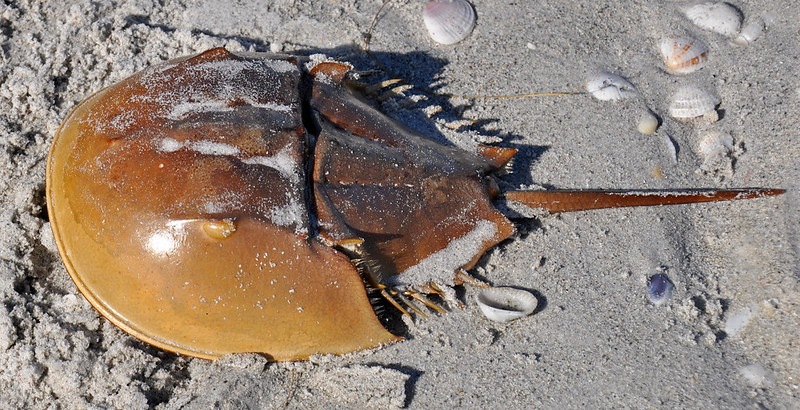

Horseshoe crabs are marine animals more closely related to spiders than crabs. These animals have existed for more than 450 million years, and are sometimes called “living fossils” because they appear to have changed very little throughout their evolutionary history. However, horseshoe crabs have a poor fossil record, so this apparent lack of change could also be due to a lack of evidence, particularly when it comes to their reproduction. Scientists want to know: Are horseshoe crabs truly living fossils?
Modern horseshoe crabs reproduce by releasing hundreds of eggs and sperm into tidal waters, via a process called external fertilization. Until now, scientists have assumed that horseshoe crabs have always reproduced this way. But paleontologists have only found 3 fossil horseshoe crabs from the past 252 million years with their reproductive systems preserved, so this assumption is mainly based on an absence of evidence to the contrary.
Scientists in the past interpreted the horseshoe crab’s long history of external fertilization as indicative of its evolutionary consistency. However, James Lamsdell and colleagues recently discovered a new fossil species of horseshoe crab in the 450 million-year-old Big Hill Formation in Michigan that challenges this assumption.
To study the specimen, the scientists photographed it under 2 types of microscopes. The first type of microscope used polarized light to see structures in the fossil that may have blended into the rock, like putting on special glasses to see subtle textures. The second type of microscope used fluorescent light to reveal soft tissue in the fossil. Only some tissues, like ovarian tissue and preserved eggs, glow under fluorescence, so this method helped the team rule out non-biological structures, like bubbles, cracks, or minerals.
The researchers found that their analytical techniques revealed remarkable details about the ancient horseshoe crab. One unique feature of the fossil was the shape of its exoskeleton. The fossil’s exoskeleton had a more shovel-like appearance than that of modern horseshoe crabs, which are less elongated and more round. It was also about 11 times smaller than a modern adult horseshoe crab.
The researchers also discovered that the fossil preserved an intricate network of ovaries containing unfertilized eggs. This ovarian network lined the interior surface of the shell in a band of interconnected tubes, preserving both unfertilized eggs and developing eggs. They noted that the fossil eggs were all about 0.1 to 0.15 millimeters in diameter, about the same width as a human hair. This size consistency suggested that all the eggs developed at the same time, via a process called synchronous development.
Since the fossil crab’s ovarian tubes contained developing eggs, it was an adult, meaning that the earliest adult horseshoe crabs were significantly smaller and shaped differently than modern adult horseshoe crabs. Despite their differences in size and shape, the fossil horseshoe crab’s reproductive system closely mirrored its modern one, in terms of its ovarian system and synchronous development of eggs. As in previous studies, it showed no evidence of internal fertilization.
The researchers concluded that the earliest horseshoe crabs also reproduced through external fertilization. This fossil horseshoe crab is more than 215 million years older than preexisting fossils preserving evidence of external fertilization, and suggests that the horseshoe crab’s mode of reproduction has been conserved for almost half a billion years!
However, the team’s findings reveal a more nuanced evolutionary history for the horseshoe crab than previously assumed. Although they’ve maintained the same reproductive system for almost half a billion years, the size and shape of their exoskeleton have changed. This discovery reveals that different parts of the horseshoe crab evolved at different rates. It seems that horseshoe crabs are not entirely the living fossils scientists once thought… while their bodies have evolved, their reproduction has endured.
