

The Milky Way Galaxy contains a diverse array of objects of different shapes and sizes. At the low end of the mass scale, you find chunks of rock, gas, and ice called comets, asteroids, and planets. As you look for more massive objects, you find glowing balls of plasma called stars, along with the rare, densely packed white dwarfs and neutron stars. At the highest-mass end of the scale, you find the supermassive black hole at the center of our Galaxy.
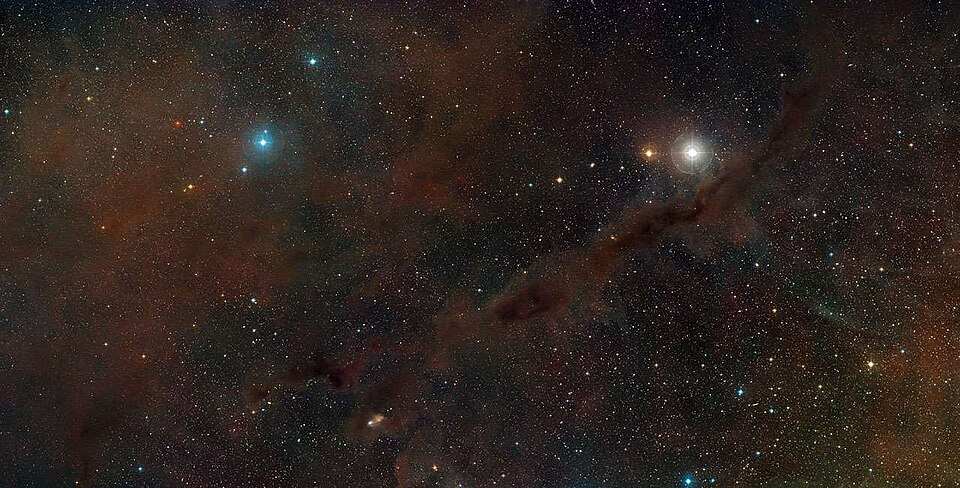
Aside from hypothetical primordial objects that existed in the immediate aftermath of the Big Bang about 14 billion years ago, all of these objects had to come from something else. Scientists think that enormous clouds of cold gas and dust, known as molecular clouds, were the precursors to the complex Galaxy we see today. Pockets of material in these clouds collapse, forming stars and the planetary systems orbiting them. Some of these stars shed their outer layers and leave behind white dwarfs, while larger ones explode as supernovae, leaving behind neutron stars and black holes.
Scientists in China use the radio telescope system at the Purple Mountain Observatory to survey the Milky Way as part of the broader Milky Way Imaging Scroll Painting (MWISP) project. One team found that in observations made in October 2024 and February through May of 2019, their radio telescope detected 3 variants of carbon monoxide molecules indicative of giant molecular clouds. Prior research has firmly established that detecting these molecules indicates vast quantities of hydrogen, so finding the former helps researchers find the latter.
The team processed these radio observations through the IRAM/GILDAS software and other processing pipelines they developed to create a map of the giant molecular cloud. They found that it is located 1,650 parsecs (pc) from Earth, roughly 50 quadrillion kilometers or 30 quadrillion miles away, and is approximately 75 pc (2 quadrillion kilometers or 1 quadrillion miles) wide and 90 pc (3 quadrillion kilometers or 2 quadrillion miles) tall. One reason their physical-dimension estimates were approximate is that the cloud has 5 spiral arms, which informed their name choice: MWISP-Spiral.
Since MWISP-Spiral formed a spiral shape with arms, the team compared it to spiral galaxies like the Milky Way. One common feature of spiral galaxies is a supermassive black hole at their centers. So, if MWISP-Spiral shares a shape with these galaxies, does it also have a black hole at its center?
To answer this question, the researchers reviewed archives of radio surveys and observations of the same region of space as MWISP-Spiral. They found a source of radio waves at the cloud’s center, relative to the ends of the 5 arms. Additionally, they found that the region occupied by MWISP-Spiral is overall empty, containing only 8 objects emitting light, none of which emitted visible light. These observations suggested that the object could be a black hole near the center of MWISP-Spiral, because material falling onto a lone black hole would produce radio emissions consistent with their findings.
Alternatively, they suggested the object could be a supermassive black hole entirely outside the Galaxy that happened to line up with the MWISP-Spiral cloud from our viewpoint. They ruled out this scenario by looking at the material around the object, which formed distinct lobes characteristic of an embedded black hole shooting out high-energy jets.
The researchers concluded that the Milky Way Galaxy contains both a giant spiral molecular cloud and a rare intermediate-mass black hole, approximately 1,500 times the mass of the Sun. The team recommended further observations of MWISP-Spiral and the object at its center to confirm their results, but suggested this system offers a unique opportunity to study how a black hole can shape molecular clouds. Beyond gas and dust dynamics, studying an intermediate-mass black hole could also help scientists learn how its supermassive relatives, like the one at the center of our galaxy, develop.
