
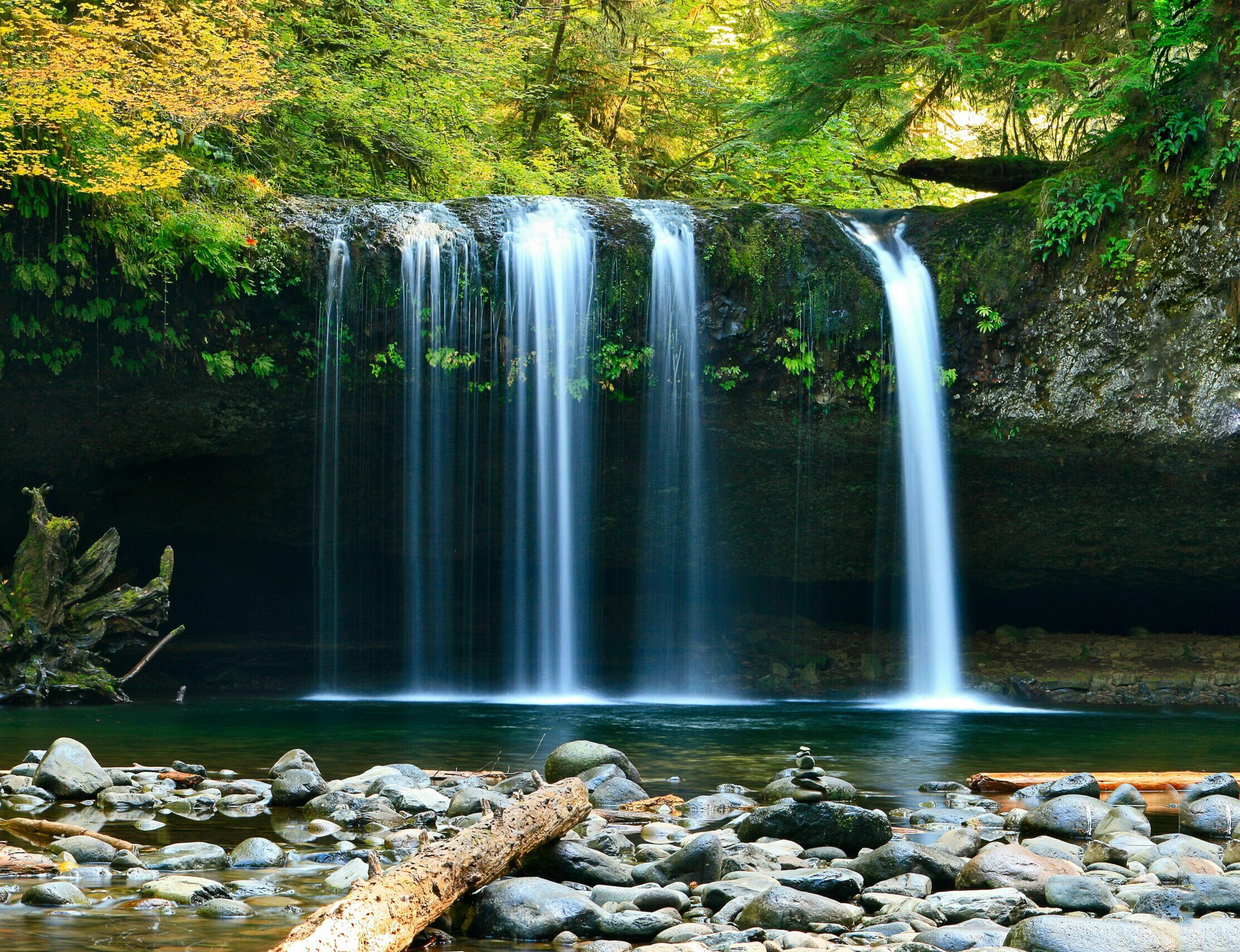

Waterfalls play an essential role in river development and landscape evolution. Researchers are particularly interested in how abrupt changes in the steepness of a river channel, also called knickpoints, develop. Knickpoints vary in size and can be as small as your index finger or as large as Niagara Falls. Researchers from Virginia hypothesized that waterfalls, a type of knickpoint, can influence erosion when a river channel is cut into solid rock, called bedrock.
The researchers wondered whether fractures and other pre-existing weaknesses can influence how water removes rock slabs from a river channel, via an erosional process called plucking. Fractures can form in many different orientations, but the researchers focused on 3. Imagine a flat tabletop that represents a riverbed. Fractures that are parallel to the flat tabletop are called horizontal fractures. If you tip the table so the low end points downstream, that’s the direction of downstream-dipping fractures. If you tip the table so the low end points upstream, that’s the direction of upstream-dipping fractures.
First, the researchers tested how fracture orientation changed erosion before an established knickpoint. They used a man-made channel, called a flume, to simulate a natural river system. To set up the experiment, they glued layers of small tiles about the size of an adult’s thumbnail to a plastic frame and put it in the flume. Then, they placed a layer of unglued tiles upstream of the knickpoint.
To begin the experiment, the researchers incrementally increased the amount of water flowing through the flume every 5 minutes until they reached a maximum flow or all the loose tiles were “eroded.” They considered a tile to be “eroded” once it was transported over the knickpoint and downstream. The researchers measured the water depth at a fixed point upstream of the knickpoint, the number of tiles eroded through plucking, and the volume of water. They repeated this 8 times for each fracture orientation.
The team found differences in the amount and timing of erosion between the 3 orientations. In particular, they saw that erosion began at lower water speeds for horizontal beds than for tilted beds. Based on the observed erosion rates, they concluded that horizontal beds are the most susceptible to erosion, while upstream-dipping beds are the most resistant, and downstream-dipping beds fall between the 2.
The researchers then tested how a knickpoint would develop and influence water flow if all of the tiles were unglued and free to move. They individually stacked almost 5,000 unglued tiles across the channel. Before starting the experiment, they filled the flume slowly with water to submerge all of the tiles without moving them. Then, they increased the water’s speed to start erosion. Instead of collecting measurements as they did in the first experiment, the researchers filmed this experiment and observed how the knickpoint shape changed and how plucking occurred.
The researchers observed that the plucked tiles in this experiment formed piles downstream of the knickpoint in a process known as armoring. This armor of tiles, which represents loose rocks near a waterfall in a natural setting, prevents erosion of the underlying river bed. Only when the water transports the armor downstream can it erode the bedrock and develop a knickpoint.
Unlike the first experiment, researchers found no differences in erosion between fracture orientations in this experiment, but did observe differences in armoring. They found that upstream-dipping beds had the least armoring because water quickly transported piles of tiles near the waterfall downstream. Downstream-dipping beds had the most armoring, and their eroded tiles took longer to move downstream.
The team concluded that waterfalls will erode at different rates based on their fracture orientation and armoring processes. The orientation of bedrock fractures also impacts the shape of the waterfall and the river channel around it. So the next time you see a large waterfall, consider that it may have started as a small fracture the size of your thumbnail.
