

About 400 million years ago, the population of plants with vein systems for transferring water and nutrients, called vascular land plants, exploded. Soon thereafter, rocks from some continental magmas showed notable shifts in their chemical compositions. Geologists have suggested that these magma changes happened worldwide, but some argue that the data might be biased because some geographic regions have more samples to analyze than others. A new research team recently tested whether these magmatic changes occurred on a global scale, versus in isolated mountain belts or volcanic islands.
Geologists use the chemistry of rocks formed from magma to understand a magma’s history. In particular, a mineral called zircon that forms from cooling magma preserves chemical clues about where the magma came from and what it interacted with. To test whether magma changes were global or local, the authors needed data ranging from the equator to the poles. Continents have shifted over the past 400 million years, so scientists use the latitude a rock had when it formed, called its paleolatitude, to compare samples from different parts of ancient Earth. To understand magma histories worldwide, the team used publicly available chemical data from zircons in magmatic rocks that formed across a wide spread of paleolatitudes.
Chemical elements with the same number of protons but different numbers of neutrons are called isotopes with different masses. To discern how plants influenced magma, the researchers analyzed 2 different isotope signals preserved in the zircons. The first isotope signal comes from the ratio of the heavy to light oxygen isotopes, which increases when sediment mixes into magma. Scientists refer to this value as δ18O, pronounced “delta 18-O.”
The second isotope signal comes from the element hafnium, denoted Hf. Geologists use hafnium to estimate how long ago magmas melted and separated from the mantle. Zircon contains 2 Hf isotopes, one of which is stable and one of which is produced by radioactive decay. Because this decay happens over billions of years, the ratio between the 2 Hf isotopes over time shifts only slightly. Geologists express these tiny differences using a shorthand called εHf, pronounced “epsilon hafnium,” which shows how much a magma’s Hf signature has changed from Earth’s original mantle. Lower εHf values indicate magmas that incorporated older crustal rock, while higher εHf values reflect mantle sources.
The researchers found that δ18O values increased as εHf values decreased in these zircons. They concluded that this trend indicates increasing amounts of land-derived sediment in magmas, corresponding with the evolution of land plants. They suggested that land plants altered the ancient landscape, changing how sediments weathered and moved over land.
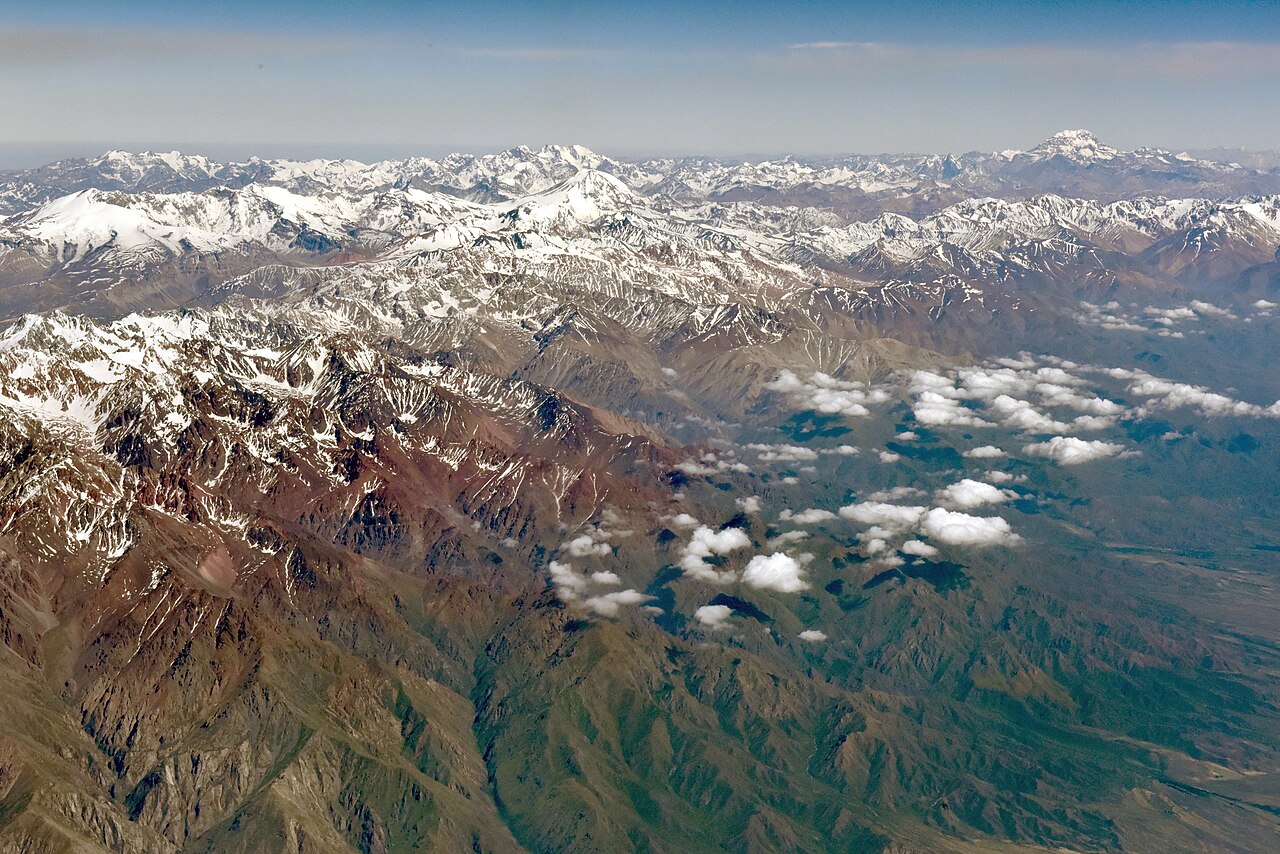
To explore this pattern in detail, the team focused on the Andes Mountains, a region that preserves a long history of magmatic activity across a long span of space and time. Using a database, they accessed isotope data from zircon samples collected in the Andes Mountains by dozens of other research groups. These samples covered 32 degrees of modern latitude and 520 million years of Earth’s history, offering a broad window into how magma chemistry changed during that time.
They found that zircons older than 450 million years had no relationship between their εHf and δ18O values. However, in zircons younger than 450 million years, δ18O increased as εHf decreased. The researchers saw this pattern in magmas that formed along the edge of the continent, where one tectonic plate sinks below the other, called a subduction zone. They also saw this pattern in magmas that formed inland, away from the subduction zone, around 200 million years ago during the breakup of the supercontinent Pangaea.
They found similar results in published zircon isotope data from igneous rocks in China, the Caribbean, Antarctica, Madagascar, and Tasmania. Zircons from each region showed the same relationship as zircons in the Andes. Since paleolatitude can also reflect ancient climate, the researchers compared the ratio of εHf and δ18O, written as εHf/δ18O, with paleolatitude to test whether ancient climate zones influenced magma chemistry. They found no link between paleolatitude and εHf/δ18O.
With these results in mind, the researchers concluded that the relationship between εHf and δ18O shifted worldwide after vascular land plants evolved. They argued that as plants spread across the continents, their roots accelerated the breakdown of rocks. This accelerated weathering produced large amounts of sediment that washed into ocean basins and was eventually subducted into the mantle, forever changing the chemistry of magma formed there. They suggested that this chain of events illustrates how life on Earth’s surface can drive changes deep within the planet.

