
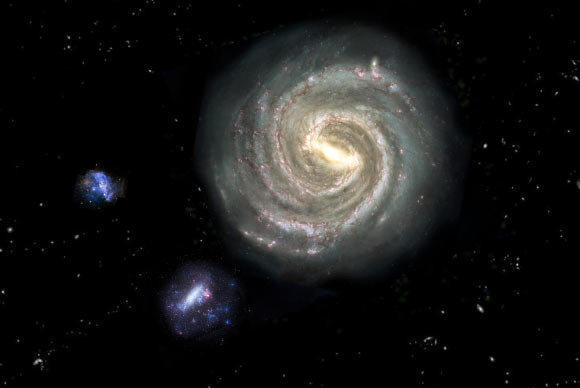

A long-running area of study in modern astrophysics is the mysterious dark matter. Since Vera Rubin discovered in the 1970s that the outer edges of galaxies rotate faster than they ought to if they contained only visible matter, researchers have tried to describe and quantify this and related phenomena, which they group under the term dark matter. The rotation of galaxies, how light bends around galaxy clusters, the distribution of material throughout the universe, and even fluctuations in the cosmic microwave background all show that there is more stuff in the universe than astronomers can see.
According to the widely accepted model of cosmology, ΛCDM, pronounced “lambda-CDM”, dark matter is some kind of slow-moving particle or particles that have mass and exert gravitational forces but don’t interact with electromagnetism. That means not only is it invisible, but it can pass right through regular matter!
While the search for the dark matter particle is ongoing, scientists can still study its properties, such as its distribution in the Milky Way Galaxy. From the center of the Galaxy to the Sun, scientists can calculate the motions of stars accurately without having to account for dark matter. However, at distances from the center of the Galaxy beyond the center to the Sun, stars and gas clouds are influenced by the presence of unseen mass. Researchers theorize that a dark matter halo surrounds the Galaxy, extending up to 230 thousand parsecs, roughly 4 quintillion miles or 7 quintillion kilometers, from the Galaxy’s center. They think this halo could account for approximately 95% of the Galaxy’s entire mass.
A team of researchers at University College London investigated the geometry of the Milky Way’s dark matter halo. Assuming that the Milky Way Galaxy is in equilibrium, they examined the stable positions of stars in the outer reaches of the Galaxy and modeled the shape and orientation of the dark matter halo that would allow for their configuration. The team then reconciled their model with previous research on the Milky Way’s history, arriving at a more complete view of the Galaxy’s structure.
The team used 2 types of stellar data from the Gaia survey, a satellite telescope mission that mapped the Milky Way Galaxy by observing millions of stars from 2013 to 2025. The first type of data they used was the number of stars, on average, in a given volume of an older, outer region of the Galaxy called the stellar halo. They referred to this quantity as the stellar halo density. The other was the position and velocity of the stars in the stellar halo. They found that the stellar halo is oblong and tilted relative to the Milky Way Galaxy, and that this would result from a similarly shaped, but much larger, dark matter halo.
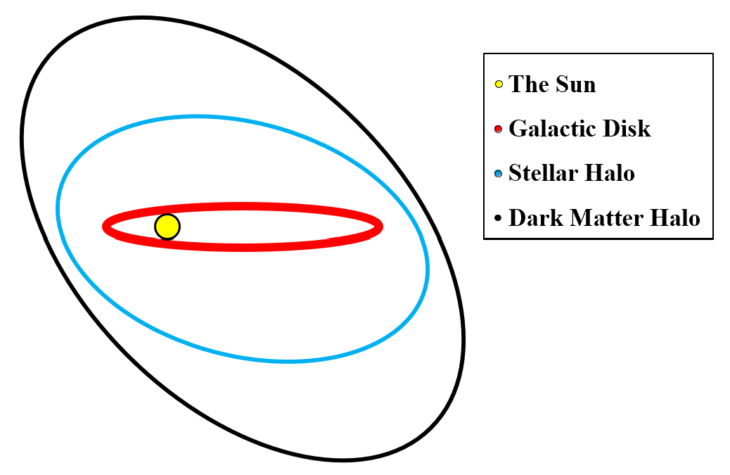
A simplified diagram of the shape and orientation of the dark matter halo compared to the stellar halo and the Milky Way Galaxy’s disk. Not to scale. By the author.
The team claimed that their findings ruled out researchers’ prior models of the dark matter halo, which suggested it was nearly spherical. They also found that the tilt of the halo with respect to the Milky Way’s disk is approximately 43°. This tilt is similar to that of other disk galaxies with dark matter halos, which are, on average, 46.5° and 18° more tilted than their stellar halos relative to their disks. They claimed that a stable, tilted, non-spherical dark matter halo means that the entire Galaxy has been stable since it collided with another galaxy at least 8 billion years ago, and more accurate measurements of the halo’s shape could help scientists better understand that merger.
For use in other research projects, the team produced a model replicating a snapshot of the Galaxy with a tilted, oblong dark matter halo incorporating the densities and motions of the stars they studied. Their simulation has additional nuances that align it with observations from the Gaia survey. These include the halo becoming more tilted at greater distances from the Galactic center, increasing from a 10° tilt to a 35° tilt over distances of 6 to 60 kiloparsecs (100 quadrillion to 1 quintillion miles, or 200 quadrillion to 2 quintillion kilometers), and becoming less oblong and more circular with distance. They suggested that future researchers can build on this model and incorporate other complex features, such as interactions between the Milky Way Galaxy and the Large Magellanic Cloud.
